I have now retired this blog-please visit my new website,
http://sophiemessager.com/
Sunday, 29 March 2015

Wednesday, 30 April 2014
Excellent new resource for all things slings
The sling pages is a new resource for all things sling, which includes a map of consultants, meets and libraries as well as links to some great articles.
Sunday, 3 November 2013
breastfeeding in a sling
Lovely video showing different ways of breastfeeding in a sling http://www.youtube.com/watch?v=wbQF7E22XUo
Thursday, 10 January 2013
using slings for daytime naps
A lovely article explaining why it makes sense to use slings for daytime naps
Monday, 30 April 2012
9 reasons not to carry your baby facing out
Carrying your baby "facing out" is not the most gentle or ergonomical way of carrying your baby in a sling-read why in this article
Sunday, 22 January 2012
International Hip Dysplasia Institute views on baby carriers
Some great pictures on the International Hip Dysplasia Institute explaining why a sling which provides a wide seat is better for hip development than the ubiquitous narrow frontpacks available on the high street.


Friday, 4 November 2011
International babywearing week event
On the 24th of October, we had a babywearing walk in Cambridge, to celebrate international babywearing week. See the press article here.


Tuesday, 16 August 2011
New facebook page
I have just created a Facebook page, which I will use to post updates and relevant links.
Friday, 5 August 2011
Cambridge Slingmeet
I run monthly SlingMeets in Cambridge and the next one is tomorrow! Come and join us from 10h30 to 12h30 at the Milton Country park cafe, or visit our Facebook Page for future dates.


Monday, 1 August 2011
Babywearing and travelling
During your travels this summer, what could be more convenient than a sling? At airports, on beaches, on country paths, in crowded city centres, in public transports, a sling allows you to carry your baby close and safe, whilst retaining usage of both of your hands. And your baby can enjoy the sight from a higher point of view than in a pushchair, and take a nap whenever he or she wants. Read more about travelling and babywearing in this great article by babywearing consultant and mum of two Olga Nguyen.


Thursday, 12 May 2011
British Association of Babywearing Instructors
The UK qualified babywearing instructors have got together and created an assocation called BABI (British Association of Babywearing Instructors), and the website has just gone live. It's still under construction, but you can have a look here, and there is a page telling you how to train to become an instructor.
Sunday, 27 March 2011
More Qualifications
I have just completed another set of babywearing instructor training this week end. This time I did the basic course with the Dresden Trageschule . It was great to meet the trainers from Trageschule UK, and I particularly enjoyed learning wrap knotting techniques and how to do carries with a short wrap. I am looking forward to passing on my new knowledge on to other parents :-)
Tuesday, 25 January 2011
Carrying your baby in a sling can help with postnatal depression
Carrying your baby close in a sling can help prevent or alleviate the symptoms of postnatal depression.
This is partly because babywearing makes mothering easier (baby cries less, sleep better, it increases the mother's confidence, and lets her have her hands free). But most importantly, the close contact between mother and baby stimulates the release of oxytocin in the mother. Oxytocin, the hormone of love and bonding, which also creates a feel-good sensation, and promotes feelings of calm and trust.
Here you can read Babywearing international's flyer on the subject
This is partly because babywearing makes mothering easier (baby cries less, sleep better, it increases the mother's confidence, and lets her have her hands free). But most importantly, the close contact between mother and baby stimulates the release of oxytocin in the mother. Oxytocin, the hormone of love and bonding, which also creates a feel-good sensation, and promotes feelings of calm and trust.
Here you can read Babywearing international's flyer on the subject
Thursday, 2 December 2010
Carrying ergonomically
When carrying a baby in a sling, it is very important to know how to position the sling and baby to allow a posture that is gentle on the baby's developing spine and hips.
At birth, a baby’s spine and hips are still immature. The spine is naturally rounded, in a c-shape, and not designed to be straight. The spine and the hip joints are still soft and flexible.
To support and protect a baby’s developing spine and hips, it is important that the carrier allows the baby to assume the “frog leg” or M position, with the knees higher than the bottom, as shown on the picture below .

Sadly, most high street "front pack" type carriers do not provide a good posture for the baby.
In this type of carrier, baby is seated with his legs dangling, with all its weight on his crotch. His back is forced into a straight position. His body is both extended and compressed.
This type of sling also places the baby too low, with the head at mid chest level, which is not a normal carrying position. Finally the design of this type of carrier and the low position of the baby are also not ergonomical for the carrying adult and carrying a heavy baby can quickly become uncomfortable.
For more info, read some articles here and here
At birth, a baby’s spine and hips are still immature. The spine is naturally rounded, in a c-shape, and not designed to be straight. The spine and the hip joints are still soft and flexible.
To support and protect a baby’s developing spine and hips, it is important that the carrier allows the baby to assume the “frog leg” or M position, with the knees higher than the bottom, as shown on the picture below .

This allows for the baby’s back to assume the correct rounded position and for the balls of the hips to sit properly in their sockets. It is also important for the carrier fabric to support the baby’s back. It is not recommended to carry your baby facing out in a sling, as it does not allow the baby to assume the frog leg position and forces the baby's back to be straight.
Sadly, most high street "front pack" type carriers do not provide a good posture for the baby.
In this type of carrier, baby is seated with his legs dangling, with all its weight on his crotch. His back is forced into a straight position. His body is both extended and compressed.
This type of sling also places the baby too low, with the head at mid chest level, which is not a normal carrying position. Finally the design of this type of carrier and the low position of the baby are also not ergonomical for the carrying adult and carrying a heavy baby can quickly become uncomfortable.
For more info, read some articles here and here
Friday, 5 November 2010
Different perspective from a sling and from a pushchair
This video shows the same scene seen by a baby sitting in a pram and by a baby in a sling on her mother's back. The difference is quite striking. The video is in Swedish but you get the message from the images
Sunday, 26 September 2010
Womb to world conference- babywearing presentation
I will be giving a talk on babywearing at the Birthlight Womb to world conference on Saturday the 2nd of October, in Cambridge.
Wednesday, 22 September 2010
How slings allowed human brain to grow
According to archeology researcher Timothy Taylor, the baby sling was the invention that allowed the human brain to achieve its current size. The development of the upright posture in humans caused a narrowing of the woman's pelvis. Human babies had to be born immature so their head would be small enough pass through the pelvis. Mothers had to keep their baby close to keep them warm and protected from predators. The invention of the sling, about 2 millions years ago, allowed mothers to nurture and protect their babies, whilst carrying on with their daily activities, and gathering food etc. This "extended gestation" outside the womb is what allowed human brains to reach their increased size.
Read the Guardian and the Humanist articles on Timothy Taylor's research.
Read the Guardian and the Humanist articles on Timothy Taylor's research.
Wednesday, 14 July 2010
Different types of slings
There are many different types of slings available to buy in the UK. They fall within 6 different categories.
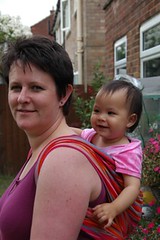 Wraps (which come in stretchy and woven varieties) are long pieces of cloth that are tied around the baby and parent.
  Mei tais are asian style carriers which consist of a rectangle of fabric with 4 straps. One set of straps tie around the wearer' waist and the other around the wearer' shoulders, the rectangle forming a pocket for the baby.
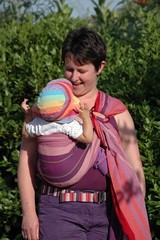 Ring slings are pieces of cloth with 2 rings sewn at one end. The free end is looped through the rings, forming a pouch for the baby, with the tail of the fabric hanging down. They are worn over one shoulder.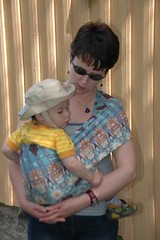
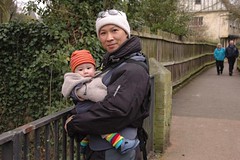 Soft structured carriers are a hybrid between a Mei Tai and a ruckscack: the body is similar to a Mei Tai but this carrier has a thick padded waist and padded shoulder straps which both fasten with buckles.
For more info, please visit slinguide
Sling safety
You may have heard about the recall of the Infantino Sling Rider earlier this year. This type of sling, known as a bag sling is unsafe for babies. There was a lot of bad press and confusion at the time, with reports of all slings being dangerous. This is not the case. When worn properly, wraps, Mei Tais, ring slings and pouches are perfectly safe.
The recall prompted the UK sling manufacturers and retailers consortium to publish this article which explains how to wear your baby safely in a sling.
So when carrying your baby in a sling, follow the TICKS rules for safe babywearing: Tight, In view at all times, Close enough to kiss, Keep chin off the chest, and Supported back.
The recall prompted the UK sling manufacturers and retailers consortium to publish this article which explains how to wear your baby safely in a sling.
So when carrying your baby in a sling, follow the TICKS rules for safe babywearing: Tight, In view at all times, Close enough to kiss, Keep chin off the chest, and Supported back.
Wednesday, 26 May 2010
Fully qualified

I am now a fully qualified babywearing consultant. Earlier this year, I invited teachers from the German Clauwi babywearing school over to Cambridge, and a few of us attended the course and gained the qualification required to become a fully fledged babywearing instructor.
It was very enjoyable and absolutely fascinating to learn all the background required to teach, including why infant are designed to be carried, the physiological development of the baby spine and hips, as well as lots of babywearing techniques and tips.
Over the last few months as my daughter Charlotte grew from being a newborn to a soon to be one year old baby, I have enjoyed experimenting with every sort of sling available, and my sling collection is now over 30!
Subscribe to:
Posts (Atom)

